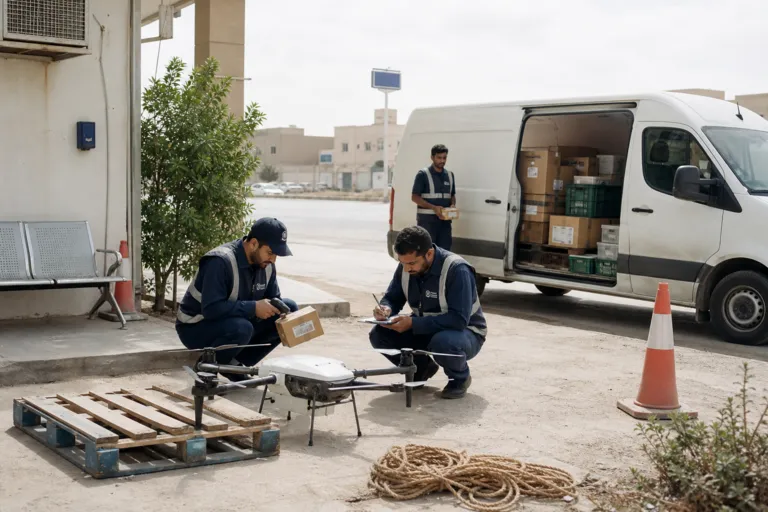
Saudi Arabia’s first postal drone delivery trial is arriving in a market where last-mile performance is becoming a national competitiveness issue. In Saudi Arabia, the last-mile delivery market is projected at USD 0.86 billion in 2026 and is expected to reach USD 1.25 billion by 2031, with a CAGR of 7.81% from 2026 to 2031. Another outlook sizes the Saudi Arabia last-mile delivery market at USD 8,100.2 million in 2025 and forecasts USD 13,248.6 million by 2033. These estimates use different methodologies, but both point to a sector expanding fast enough that new operating models, including drones, are moving from demos toward structured trials.
Demand pressure is clear in the transaction data behind the delivery surge. E-commerce orders climbed 49% year-on-year to 118 million in Q1 2026, and Riyadh alone generated 44% of orders. That concentration helps carriers build dense routes, yet it also raises customer expectations as platforms try to compress delivery windows through AI-enabled hubs and neighborhood-level micro-fulfillment. Payments behavior reinforces the shift: digital payments account for 79% of transactions, and 96% of point-of-sale interactions are contactless. As volumes rise and service promises tighten, the logistics stack has to evolve beyond traditional courier playbooks.
Why the Postal Drone Trial Matters in the Last-Mile Race
The strongest case for a Saudi drone parcel delivery pilot is not novelty. It is the economics of geography and addressability. Sparse-population routes can double per-package costs versus city drops in Saudi Arabia’s hinterlands, and non-standardized addresses delay routing-algorithm efficacy. Sources note that consolidated pick-up points and drone pilot trials can offset part of the gap, although breakeven timelines stretch for independent couriers. This is also why unresolved address-standardization outside tier-1 cities is flagged as a contributor to high first-attempt failure rates. Drones do not fix addressing alone, but they can become a targeted tool where road distance, time, or repeated delivery attempts erode margins.
Regulation and market structure are moving in parallel with experimentation. April 2024 courier-licensing reforms formalized 37 operators, channeling gig deliveries into compliant networks and raising service standards. At the same time, service mix is shifting. Standard delivery captured 62.57% of the Saudi Arabia last-mile delivery market share in 2025, while same-day delivery is projected to grow at a 9.46% CAGR through 2031. B2C flows commanded 71.6% of market size in 2025, and e-commerce retail led end-user revenue share at 38.25%. The pressure to meet faster promises at scale is a practical driver for testing autonomous options alongside conventional fleets.
Autonomy is also becoming a category in its own right. Grand View Research places the Saudi Arabia autonomous last mile delivery market at USD 6.4 million in 2024, projected to reach USD 28.7 million by 2030, with a CAGR of 28.9% from 2025 to 2030. In that segmentation, ground delivery vehicles led revenue in 2024, while aerial delivery drones are described as the most lucrative and fastest-growing platform segment in the forecast period. Separate research frames a broader autonomous last-mile track for Saudi Arabia at USD 268.42 million rising to USD 724.14 million, with an 11.0% CAGR, tied to Vision 2030 automation goals. Together, these outlooks explain why a postal drone trial is less a side project and more a signal in a widening last-mile race.
What is driving urgency behind Saudi Arabia’s postal drone delivery trial?
How big is the Saudi Arabia last-mile delivery market in recent forecasts?
How does same-day delivery fit into the last-mile race?
What does the Saudi drone parcel delivery pilot suggest about autonomous delivery growth?
Talk to us for your needs in:
- Identifying Suitable Warehouse Sites in Saudi Arabia
- Customized Logistics and Supply Chain Analytics
- Logistics Network Design and Optimization
- Green Supply Chain and Sustainable Logistics Solutions
- Supply Chain Risk Management and Compliance
- Advanced Supply Chain Resilience and Agility
- Logistics Market Research and Strategic Analysis
- In-Depth Market Survey for Logistics
- Market Intelligence and Insights in Logistics
- Feasibility Study and Assessment in Logistics
- Integrated Warehousing Management Solutions
- Smart Warehousing and Automation Systems
- Sustainable and Green Warehousing Practices
- Port and Airport Logistics Optimization
- Digital Logistics Solutions
- Saudi Logistics Benchmarking