Saudi Arabia’s Crown Prince approved the Kingdom’s 2026 state budget with total expenditures set at SAR 1.313 trillion and projected revenues of SAR 1.147 trillion. This creates a fiscal deficit that the government presents as a deliberate policy choice. The approach keeps public spending central to economic transformation under Vision 2030, while adjusting what spending is meant to achieve.
For companies in shipping, warehousing, transport, construction, and industrial supply chains, the message is clear. The budget continues to back infrastructure-led development, but with more pressure on efficiency. KPMG notes that total public expenditure is projected to decline from an estimated SAR 1,336 billion in 2025 to SAR 1,313 billion in 2026, tied to a public-sector spending efficiency agenda that aims to reduce costs while improving service quality.
At the same time, the government is signaling a shift in priorities. Reuters reports that Saudi Arabia is shifting spending to priority sectors like industry and logistics to increase non-oil revenue. Finance Minister Mohammed Al Jadaan described it as consistent spending levels over the last three budget cycles, but now focused more on what the Kingdom is spending on rather than how much it is spending.
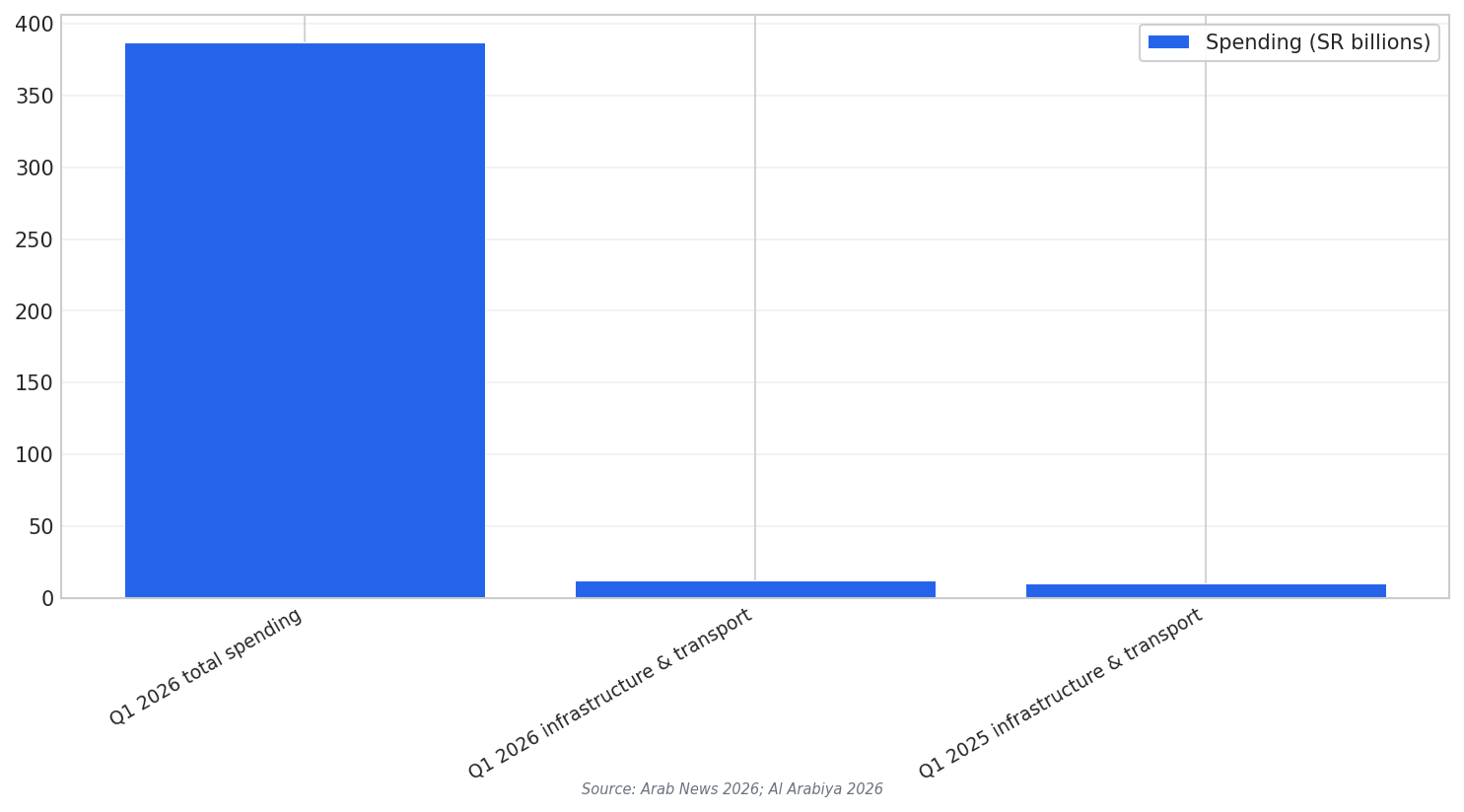
Early 2026 results show how transport and infrastructure are being treated as an active lever for logistics transformation. In Q1 2026, spending rose to 387 billion riyals, and expenditure on infrastructure and transport rose 26 percent to SR12 billion. For context, Arab News also compares this with roughly SR10 billion in Q1 2025, showing a higher starting pace in 2026.
What the 2026 CAPEX Plan Means for Logistics
The budget also sets out a large capital expenditure envelope. Middle East Briefing reports SAR 162 billion allocated to capital expenditure in 2026. It says capital spending is directed toward transport systems, utilities, urban development, and large-scale national projects, with transport a central beneficiary through airport expansions, rail networks, and integrated transit systems aimed at improving domestic mobility and international connectivity.
For logistics operators and investors, this mix matters because it links assets together. Middle East Briefing says transport investments support Saudi Arabia’s logistics ambitions and broader objectives in tourism, trade facilitation, and regional integration. It also points to expanding private-sector participation as a long-term opportunity, while warning that cost pressures and regulatory complexity remain key challenges.
What is changing in Saudi Arabia 2026 budget logistics priorities?
How much is Saudi Arabia planning to spend and earn in 2026?
How much capital expenditure is allocated in the 2026 budget?
What do the Q1 2026 budget results say about transport and infrastructure spending?
Talk to us for your needs in:
- Identifying Suitable Warehouse Sites in Saudi Arabia
- Customized Logistics and Supply Chain Analytics
- Logistics Network Design and Optimization
- Green Supply Chain and Sustainable Logistics Solutions
- Supply Chain Risk Management and Compliance
- Advanced Supply Chain Resilience and Agility
- Logistics Market Research and Strategic Analysis
- In-Depth Market Survey for Logistics
- Market Intelligence and Insights in Logistics
- Feasibility Study and Assessment in Logistics
- Integrated Warehousing Management Solutions
- Smart Warehousing and Automation Systems
- Sustainable and Green Warehousing Practices
- Port and Airport Logistics Optimization
- Digital Logistics Solutions
- Saudi Logistics Benchmarking