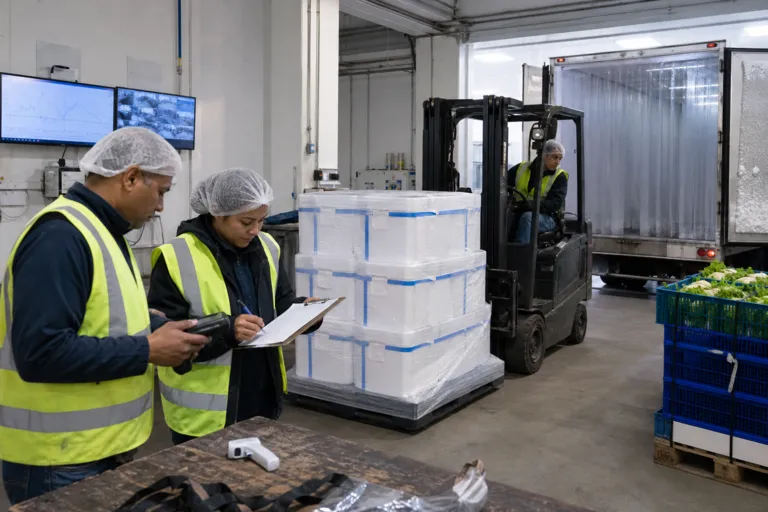
Food and vaccines share a common weak point: temperature control. Cold chain logistics covers refrigerated storage, refrigerated transport, and handling designed to keep products within required conditions across storage and distribution. Global forecasts underline how quickly this capability is becoming a strategic asset. Custom Market Insights projects the global cold chain logistics market at USD 260 billion in 2024, with an expected 10.9% CAGR from 2024 to 2033, reaching USD 477 billion by 2033. Fortune Business Insights values the global market at USD 293.58 billion in 2023 and projects USD 862.33 billion by 2032. In that backdrop, NIDLP cold chain infrastructure funding can be framed as a push to harden the systems that protect both food quality and medical product integrity.
Cold chain growth is not just about more chilled food deliveries. It is also about higher standards and more complex healthcare products. The market is pushed by strict regulations and quality standards, with compliance needs such as Good Distribution Practice (GDP) and Hazard Analysis and Critical Control Points (HACCP) shaping investment decisions. Global Market Insights describes expansion in pharmaceutical and vaccine distribution as a driver, noting that advanced therapies such as mRNA vaccines need strict temperature control during transportation. Mordor Intelligence also highlights that distribution of mRNA vaccines, cell therapies, and other biologics requiring storage below -70 °C is driving an 8.5% CAGR in the deep-frozen segment. These realities explain why cold chain investment can directly support vaccine reliability, not only general logistics efficiency.
Why Capacity, Compliance, and Power Reliability Matter
Capacity figures show how large-scale cold chain systems can become when markets prioritize them. Mordor Intelligence reports that North America generated 34% of 2024 revenue and operates 5 billion ft³ of refrigerated space, with more than four-fifths of that space in the United States. In the United States market specifically, Mordor Intelligence values the US cold chain logistics market at USD 97.13 billion in 2026, forecasting growth to USD 133.87 billion by 2031 at a 6.63% CAGR. It also reports that refrigerated storage held a 57.53% share in 2025. For healthcare-grade space, GDP-compliant providers can command lease rates up to USD 22 per ft² in Boston, compared to USD 8–12 for food-grade space. That gap reflects the value at risk when temperatures drift or custody records fail.
Investment pressure also comes from monitoring and traceability requirements. Mordor Intelligence forecasts that, as compliance deadlines approach, capital outlays for telematics solutions will exceed USD 5 billion annually. These systems support temperature logging, alerts, and recordkeeping. DataM Intelligence describes sensor-based systems that continuously track temperature and humidity, alerting providers to deviations to protect sensitive vaccines and biologics. The operational environment can matter as much as the warehouse design. Mordor Intelligence notes that cold stores in Nigeria, Kenya, and Ghana face grid outages exceeding 500 hours per year, forcing diesel generator backup and pushing energy costs to 60% of operating expenses versus 35% in developed markets. For any cold chain push focused on security outcomes, stable power, monitoring, and documented compliance become part of the core infrastructure, not optional add-ons.
Food security and vaccine security also compete for the same assets: transport capacity, storage slots, and trained operators. Mordor Intelligence states that the cold chain logistics market increasingly allocates capacity to healthcare even in traditionally food-dominated facilities, as clinical trial material moves require strict chain-of-custody and aggressive lead times. At the same time, refrigerated transportation is expected to grow quickly, with Mordor Intelligence citing a 7.1% CAGR as e-commerce and quick-commerce accelerate time-critical deliveries. This cross-pressure is exactly why NIDLP cold chain infrastructure funding needs a balanced design approach, aligning food-grade throughput with healthcare-grade controls. Global forecasts—from a USD 361.37 billion market in 2025 projected to reach USD 492.40 billion by 2030 at a 6.38% CAGR, to larger long-horizon projections elsewhere—signal that demand will keep rising, and investment choices made now can determine whether capacity serves both needs or forces tradeoffs.
Why does cold chain investment affect both food and vaccine security?
What global growth signals support prioritizing cold chain infrastructure?
How do compliance requirements shape cold chain spending?
What does the US market reveal about the value of healthcare-grade cold chain space?
How should NIDLP cold chain infrastructure funding be framed to reduce tradeoffs?
Talk to us for your needs in:
- Identifying Suitable Warehouse Sites in Saudi Arabia
- Customized Logistics and Supply Chain Analytics
- Logistics Network Design and Optimization
- Green Supply Chain and Sustainable Logistics Solutions
- Supply Chain Risk Management and Compliance
- Advanced Supply Chain Resilience and Agility
- Logistics Market Research and Strategic Analysis
- In-Depth Market Survey for Logistics
- Market Intelligence and Insights in Logistics
- Feasibility Study and Assessment in Logistics
- Integrated Warehousing Management Solutions
- Smart Warehousing and Automation Systems
- Sustainable and Green Warehousing Practices
- Port and Airport Logistics Optimization
- Digital Logistics Solutions
- Saudi Logistics Benchmarking