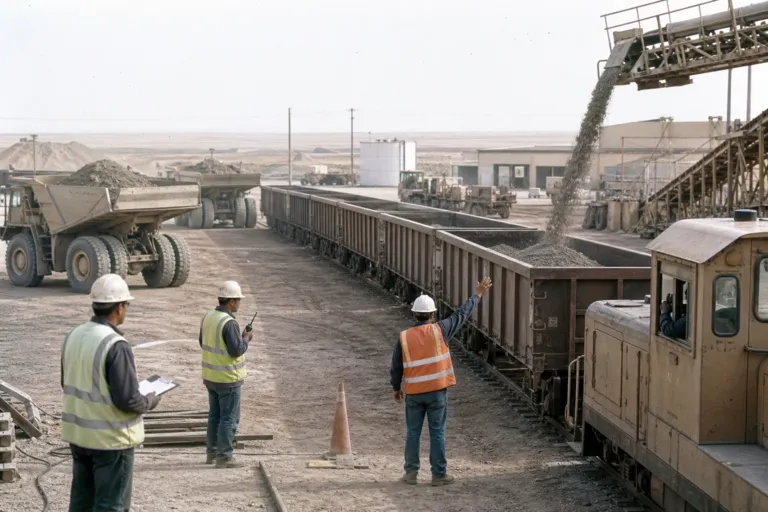
Saudi Arabia’s mining push is moving beyond extraction and into processing, jobs, and exports. Arab News reports the Kingdom’s mineral wealth is valued at $2.5 trillion, and it also reports that mining is projected to boost its contribution to GDP from $17 billion in 2024 to $75 billion by 2030. That shift creates a practical bottleneck: minerals must move reliably from sites to processing hubs and then to export routes. Within that context, Wa’ad Al-Shamal is repeatedly described as a phosphate-focused production and processing center tied to export markets, making transport planning and corridor reliability central to the growth story.
Multiple sources place Wa’ad Al-Shamal in the Northern Borders Region and link it directly to phosphate. Discovery Alert states the Northern Borders Region contains approximately half of the Kingdom’s identified high-grade mineral concentrations, with Wa’ad Al-Shamal City functioning as a major integrated phosphate production and processing hub. A separate Discovery Alert report adds that Wa’ad Al-Shamal focuses on phosphate extraction and processing for fertiliser export markets, and that the site’s infrastructure is designed to support long-haul mineral logistics connecting to Red Sea port facilities. This pairing of processing capability and transport design is the foundation for how volumes can scale without relying on ad hoc shipping solutions.
From Remote-Region Output to Export-Ready Industrial Clusters
Saudi policy and investment signals suggest export capacity is being built alongside downstream value-add. Discovery Alert reports government officials have set targets for $100 billion in downstream processing investments by 2035, with $32 billion already committed to development or construction phases across multiple mineral categories. Arab News also notes a $100 billion investment plan targeting critical minerals by 2035, while emphasizing the strategic role of integrated processing in places like Ras Al-Khair. In this environment, Wa’ad Al-Shamal’s cluster model matters because it links extraction, processing, and outbound routes, reducing the risk that exports are constrained by geography rather than demand.
Industrial clustering is also being presented as an engine for new permits and manufacturing pull-through. Discovery Alert cites Saurabh Priyadarshi describing the cluster approach at Ras Al-Khair and Wa’ad Al-Shamal as having attracted SR250 billion in planned investments and generated over 1,300 new industrial licences. Arab News adds that developments in Waad Al-Shamal have helped position the Kingdom among the world’s top phosphate exporters. Taken together, the narrative is clear: logistics is not a side issue. It is a core enabler that helps remote production translate into repeatable export performance and supports industrial activity that depends on steady mineral throughput.
Scaling exports also depends on operational capacity inside mines and processing plants, not only on transport lanes. Mordor Intelligence estimates the Saudi Arabia mining equipment market at USD 7.32 billion in 2025, and expects it to reach USD 9.72 billion by 2030, at a CAGR of 5.83%. It also reports that diesel held a 75.16% share by power source in 2024, while battery-electric is projected to post a 16.31% CAGR between 2025 and 2030. For Wa’ad Al-Shamal, the implication is straightforward: as equipment capability expands and processing ambitions rise, logistics design and reliability will increasingly define how efficiently phosphate output reaches export corridors.
Why is Wa’ad Al-Shamal important to Saudi mining exports?
What does Saudi Arabia project for mining’s GDP contribution?
What downstream investment targets are linked to Saudi mineral transformation?
How does the Waad Al Shamal mining logistics focus show up in the sources?
What signals show mining operations are scaling in Saudi Arabia?
Talk to us for your needs in:
- Identifying Suitable Warehouse Sites in Saudi Arabia
- Customized Logistics and Supply Chain Analytics
- Logistics Network Design and Optimization
- Green Supply Chain and Sustainable Logistics Solutions
- Supply Chain Risk Management and Compliance
- Advanced Supply Chain Resilience and Agility
- Logistics Market Research and Strategic Analysis
- In-Depth Market Survey for Logistics
- Market Intelligence and Insights in Logistics
- Feasibility Study and Assessment in Logistics
- Integrated Warehousing Management Solutions
- Smart Warehousing and Automation Systems
- Sustainable and Green Warehousing Practices
- Port and Airport Logistics Optimization
- Digital Logistics Solutions
- Saudi Logistics Benchmarking