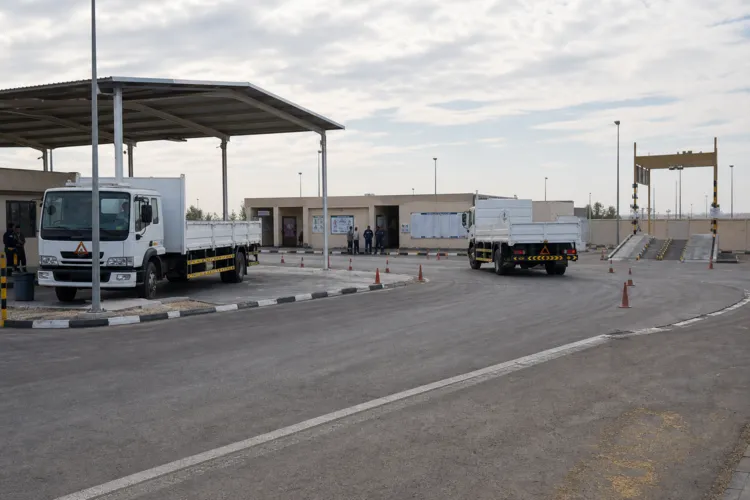
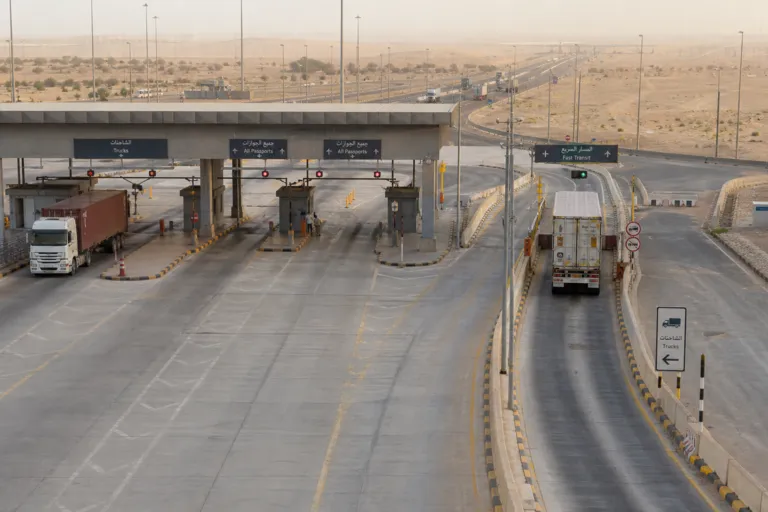
In 2026, Gulf routing decisions shifted from a single question about port clearance to a broader question about end-to-end corridor reliability. Several sources tie this shift to both disruption risk and customs process reform. Delays at internal checkpoints have historically slowed truck movements among GCC member states, and those delays became more visible as cargo was pushed onto road networks connecting accessible ports to inland markets. At the regional level, trade facilitation is also advancing through digitised customs and transit tools, including the GCC Unified Customs Transit system, which enables cargo to move across multiple member states under a single guarantee and minimises documentation requirements at internal borders. In practice, the operational aim is fewer repeated steps at borders, with more decisions made through digital data exchange.
Saudi Arabia’s sea-to-air corridor illustrates how “one declaration” logic is being applied in real operations. In March 2026, Saudia Cargo, Mawani, and ZATCA launched a sea-to-air logistics corridor through the Kingdom’s western ports, centred on gateways such as Jeddah Islamic Port. The stated model is that ocean cargo arrives at a Red Sea port and then transfers to air freight for onward distribution. The key enabler described is paperwork integration: ZATCA links the sea and air gateways under a single transit framework so a consignment can move on one customs declaration with pre-clearance and smart inspection, rather than two separate clearances. Saudia Cargo then feeds that flow into a network reaching roughly 100 airport destinations, supporting time-sensitive freight such as pharmaceuticals, perishables, and high-value e-commerce.
What Changed on the Ground in 2026: Ports, Highways, and Declarations
Capacity and routing options are also changing the practical calculus for forwarders. Jeddah Islamic Port handled just over 3 million TEU in 2024 and now carries capacity above 10 million TEU, with King Abdullah Port adding another 5 million TEU of capacity. On the roads, the disruption-driven shift to land corridors highlighted where customs friction still bites. IndexBox describes Highway 40 running 850 miles from Jeddah through Riyadh to Bahrain and Dammam, and Highway 10 branching from Riyadh to the UAE. It also notes that Highway 95 gained popularity because it shortens distance and avoids often 24-hour delays at UAE-Saudi border crossings. These pressures helped make the GCC conversation less about a single port and more about predictable, cross-border transit execution.
UAE-Oman checkpoint changes show how quickly flows can swing when procedures are streamlined. Dubai and Sharjah agreed on new customs procedures with Oman to expedite movement through the Hatta, Khatmat Malaha, and Al Madam checkpoints for loads originating in Omani ports. At Dubai’s Hatta checkpoint alone, the value of customs declarations rose from $270 million in March to $2.16 billion in April. Another example is the Ramlet Khelah border crossing (opened in January 2023), where the value of goods nearly tripled to $830 million in March from $300 million in February. For planners building a GCC customs union single declaration approach, these examples underline a core lesson: when declarations and inspections are handled more consistently, routing choices can change in weeks, not years.
These reforms sit alongside broader market expansion that raises the stakes for speed and compliance. Mordor Intelligence reports the GCC air freight transport market is set to climb from USD 19.39 billion in 2026 to USD 27.45 billion by 2031, a 7.2% CAGR, with general cargo accounting for 71.18% in 2025 and special cargo projected to expand at an 8.26% CAGR over 2026–2031. On the storage side, the GCC warehousing and distribution logistics market is valued at USD 15.40 billion in 2026 and is forecast to reach USD 20.94 billion by 2031 at a 6.34% CAGR. With unified GCC customs codes effective January 2025 simplifying clearance across borders (while VAT regimes and local-content rules maintain complexity), the direction of travel is clear: more cargo is being designed to move across the region with fewer repetitive border steps, supported by digital exchange and unified transit mechanisms.
What does a GCC customs union single declaration mean in 2026 transit operations?
Which 2026 project demonstrates one-declaration movement between sea and air in Saudi Arabia?
What figures show how fast customs flows changed at UAE-Oman checkpoints?
What border-crossing numbers highlight rising use of the Ramlet Khelah route?
What market growth trends raise the importance of faster, cleaner cross-border processing?
Talk to us for your needs in:
- Identifying Suitable Warehouse Sites in Saudi Arabia
- Customized Logistics and Supply Chain Analytics
- Logistics Network Design and Optimization
- Green Supply Chain and Sustainable Logistics Solutions
- Supply Chain Risk Management and Compliance
- Advanced Supply Chain Resilience and Agility
- Logistics Market Research and Strategic Analysis
- In-Depth Market Survey for Logistics
- Market Intelligence and Insights in Logistics
- Feasibility Study and Assessment in Logistics
- Integrated Warehousing Management Solutions
- Smart Warehousing and Automation Systems
- Sustainable and Green Warehousing Practices
- Port and Airport Logistics Optimization
- Digital Logistics Solutions
- Saudi Logistics Benchmarking