Building toward NEOM autonomous last-mile delivery targets demands two things at once: operational discipline and regulatory clarity. Globally, last-mile delivery is a large and expanding market. Straits Research values the global last mile delivery market at USD 177 billion in 2025 and projects growth from USD 194.34 billion in 2026 to USD 410.57 billion by 2034, at a CAGR of 9.8% (2026–2034). That scale matters for NEOM planning because it signals vendor maturity, competition among providers, and rapid technology iteration. In the same source, autonomous vehicles are the fastest-growing technology segment, expected to grow at a CAGR of 23.8% during the forecast period, which supports a roadmap built around automation rather than incremental manual optimization.
Partner selection should start with what the data says about where last-mile demand concentrates and what applications dominate. Straits Research reports that B2C accounts for 69.6% of last-mile delivery in 2025, and e-commerce accounts for 52.6% of applications, while regular delivery is 64.7% of delivery time share. For NEOM, that implies that autonomous deployments cannot be designed only for premium “demo” use cases. They must also handle routine, repeatable residential-style drops and the operational cadence of e-commerce fulfillment. Working with TGA-licensed partners makes that transition less fragile, because licensing requirements can be treated as a gating item for pilots, scaling, and service-level commitments, rather than an afterthought once vehicles are already in the field.
What TGA-Licensed Partners Should Prove Before Scaling
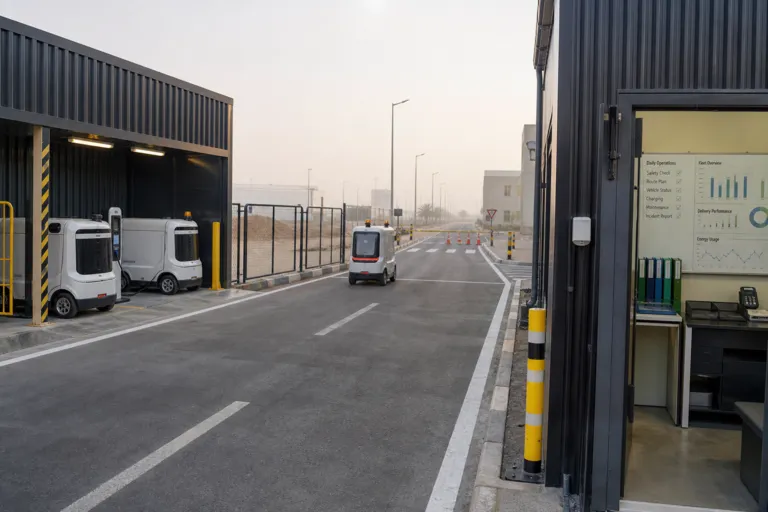
NEOM can ask TGA-licensed partners to evidence performance using benchmarks that appear in published market research, while keeping local outcomes measured separately. GM Insights notes that most e-commerce and food delivery services operate within a 2–15-kilometer range, which aligns with autonomous platform constraints cited in the same source: drones at 40–60 km and ground robots at 15–30 km. GM Insights also describes delivery economics in dense routes, where a single vehicle can complete 20–40 deliveries per shift. These figures can be converted into contractual KPIs for trials: range suitability, battery-fit route design, and minimum deliveries-per-shift targets. They also support a practical “micro-fulfillment to doorstep” architecture, where route optimization and fleet management become core deliverables from licensed partners, not optional add-ons.
Market deployment signals also show how quickly autonomous systems are moving from tests to real operations, which is relevant when NEOM sequences pilots and procurement. IndustryResearch.biz reports that in 2024, more than 48,000 autonomous ground vehicles and drones were deployed globally for last-mile logistics, a 56% increase from 2022. The same source states that, as of 2025, over 1,000 pilot programs across 40 countries are testing autonomous delivery systems. NEOM can use these global indicators as context when negotiating with TGA-licensed partners: vendors should demonstrate which elements of their stack are already proven in pilots, how they manage route authorization, and how they operationalize fleet monitoring and exception handling. This approach helps prevent “pilot theater” and keeps a line of sight from trial design to scaled service.
Finally, NEOM’s autonomous last-mile ambition is supported by the direction of the global autonomous segment itself. DataM Intelligence says the global autonomous last-mile delivery market reached US$ 1.39 billion in 2025 and is expected to reach US$ 7.74 billion by 2033, growing at a CAGR of 24.0% (2026–2033). GM Insights similarly estimates the market at USD 1.3 billion in 2025 and forecasts a 24.5% CAGR between 2026 and 2035. These are global figures, not NEOM or Saudi Arabia-specific results, but they reinforce an important execution lesson: NEOM should structure agreements with TGA-licensed partners to absorb rapid tech change, including software updates, sensor improvements, and fleet expansion, while maintaining compliance and operational reliability as non-negotiable requirements.
How can NEOM structure partnerships to reach an autonomous last-mile delivery target?
Which last-mile segments matter most when designing autonomous delivery services?
What global deployment signals suggest autonomous last-mile delivery is scaling?
How fast is the autonomous last-mile delivery market growing globally?
Talk to us for your needs in:
- Identifying Suitable Warehouse Sites in Saudi Arabia
- Customized Logistics and Supply Chain Analytics
- Logistics Network Design and Optimization
- Green Supply Chain and Sustainable Logistics Solutions
- Supply Chain Risk Management and Compliance
- Advanced Supply Chain Resilience and Agility
- Logistics Market Research and Strategic Analysis
- In-Depth Market Survey for Logistics
- Market Intelligence and Insights in Logistics
- Feasibility Study and Assessment in Logistics
- Integrated Warehousing Management Solutions
- Smart Warehousing and Automation Systems
- Sustainable and Green Warehousing Practices
- Port and Airport Logistics Optimization
- Digital Logistics Solutions
- Saudi Logistics Benchmarking