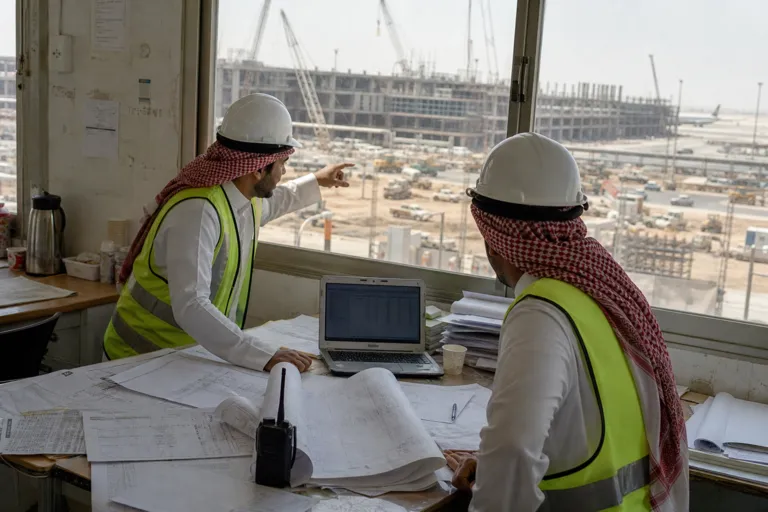
King Salman International Airport is an international airport under development that would serve Riyadh, the capital of Saudi Arabia, and succeed the current King Khalid International Airport while being built around it. The master plan was proposed in December 2022 as part of Saudi Arabia’s Vision 2030, with the stated goal of boosting tourism and supporting socio-economic development. The airport is being designed by Foster + Partners, with engineering consultancy Jacobs, and Aviation Week also cites Mace and Saudi company Nera as part of the design-and-build appointments by the King Salman International Airport Development Company. The project is framed as making Riyadh a gateway to the world and reinforcing the Kingdom’s position as a global logistics hub.
The planned physical scale and layout are central to why Riyadh cargo stakeholders are watching the development closely. The airport covers 57 km² and includes six passenger terminals, an iconic terminal, a private aviation terminal, and six runways, alongside other facilities and amenities. It is planned to have a single concourse area with a loop connecting terminals, with multiple entrances and exits, and a reserved 4.2 sq. mi. area for retail and office space. A separate Saudi Arabia travel industry report also describes 12 km² of support facilities, housing, retail, and logistics zones, and notes the plan to integrate King Khalid Airport terminals. These details matter for cargo because they indicate space for logistics zones, airside support, and surface access built into the wider airport district.
Cargo Capacity Targets and the Operational Model Taking Shape
On throughput targets, the sources provide multiple milestones, and they should be read as targets rather than current volumes. Wikipedia states the airport wants to handle 100 million passengers per year by 2030 and 185 million passengers per year by 2050, and it also wants to handle 3.5 million tonnes of cargo per year by 2050. Aviation Week reports that future development phases will increase capacity to up to 100 million passengers in 2030 and include the capacity to process 2 million tons of cargo. A separate Saudi Arabia travel report cites a target of 120 mn passengers by 2030f and 185 mn by 2050f, alongside 3.5 mn tons of cargo. Aviation Week also notes that connectivity from passenger terminals to cargo areas is being prioritized to reflect the importance of belly cargo in operations and to improve the Kingdom’s logistic performance index to be among the top 10 globally.
Riyadh’s wider freight and airport-equipment ecosystem provides additional context for how King Salman airport air cargo could be enabled on the ground. A market insight report citing IMARC Group says the Saudi Arabia ground support equipment market size reached USD 152.3 Million in 2024 and is projected to reach USD 275.6 Million by 2033, with a CAGR of 6.11% during 2025-2033. The same report describes AI-powered sensors for predictive maintenance, stating airlines deploying these systems report maintenance cost reductions of 25-35% and unplanned downtime cuts of up to 70%. Separately, a Saudi Arabia travel report says cargo volumes fell 5% YoY, while passenger and flight numbers grew by 7% and 4% YoY, respectively, describing a temporary slowdown expected to ease as aviation activity continues. Together, these points highlight that both capacity buildout and operational efficiency tools are being discussed alongside shifting demand signals.
Logistics zoning and trade facilitation mechanisms are also appearing in forecasts about Riyadh’s air-freight future. Mordor Intelligence describes the Special Integrated Logistics Zone at King Khalid International Airport as spanning 32 million ft², offering duty-deferred storage and automated clearance, and says it is slashing average e-parcel customs release times below two hours. The same source adds that similar bonded nodes near King Salman International Airport create a China-KSA gateway channeling 20.9% of Saudi inbound trade. It also reports that, in May 2024, SAL Saudi Logistics Services committed USD 93 million to 90,000 m² of new air-cargo capacity at King Khalid International Airport. These adjacent developments help explain the direction of travel: paired airport capacity targets, bonded logistics nodes, and new cargo facilities can combine to strengthen Riyadh’s role in trade flows as the new airport develops.
What is King Salman International Airport, and where is it being built?
What cargo capacity is planned for King Salman International Airport?
How is the airport design addressing cargo operations?
How could bonded logistics zones influence Riyadh air freight near the new airport?
What should businesses watch in the King Salman airport air cargo buildout?
Talk to us for your needs in:
- Identifying Suitable Warehouse Sites in Saudi Arabia
- Customized Logistics and Supply Chain Analytics
- Logistics Network Design and Optimization
- Green Supply Chain and Sustainable Logistics Solutions
- Supply Chain Risk Management and Compliance
- Advanced Supply Chain Resilience and Agility
- Logistics Market Research and Strategic Analysis
- In-Depth Market Survey for Logistics
- Market Intelligence and Insights in Logistics
- Feasibility Study and Assessment in Logistics
- Integrated Warehousing Management Solutions
- Smart Warehousing and Automation Systems
- Sustainable and Green Warehousing Practices
- Port and Airport Logistics Optimization
- Digital Logistics Solutions
- Saudi Logistics Benchmarking