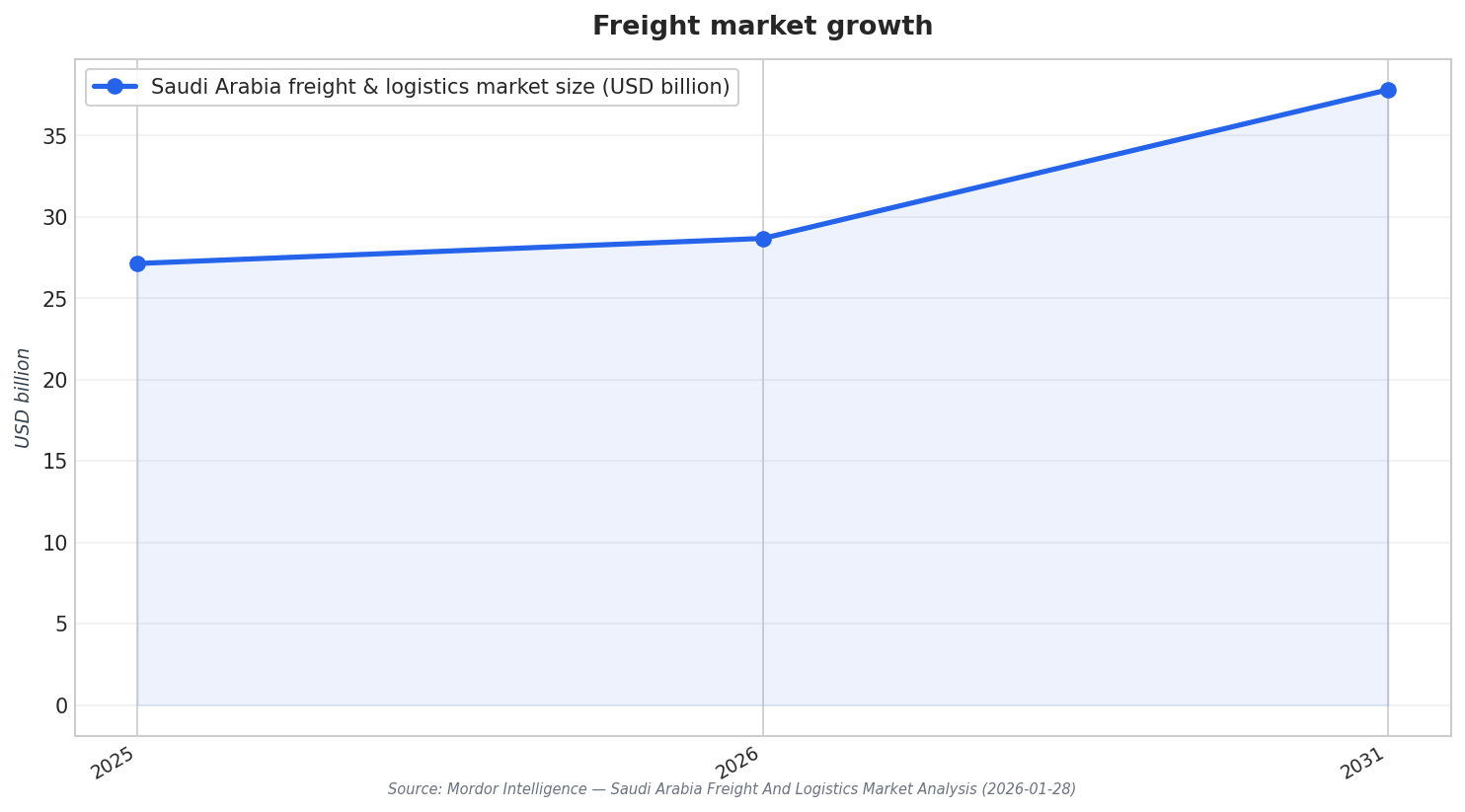
Saudi Arabia’s logistics upgrade cycle is being shaped by infrastructure spending, new corridors, and demand shifts in freight and warehousing. Mordor Intelligence values the Saudi freight and logistics market at USD 27.14 billion in 2025 and estimates growth from USD 28.68 billion in 2026 to USD 37.82 billion by 2031, at a CAGR of 5.69% (2026–2031). In parallel, the Saudi third-party logistics (3PL) market is valued at USD 12.39 billion in 2025 and is estimated to reach USD 16.54 billion by 2031 at a 4.91% CAGR (2026–2031). This macro momentum frames why integrated nodes near key Gulf gateways matter, especially when inland links can raise service reliability and expand route choices.
Port capability and inland transfer options are central to the Dammam integrated logistics zone story. Nexdigm cites port handling capacities of over 105 million TEU at King Abdulaziz Port in Dammam and over 130 million TEU at Jeddah Islamic Port. The same source adds that, as of early 2024, infrastructure enhancements including port modernization investments of 4.5 billion SAR enabled handling of more than 25 million tons of cargo annually at key ports. In January 2026, IMARC’s press-release summary notes MEDLOG opened an integrated logistics park at King Abdulaziz Port in Dammam with advanced multimodal connectivity and smart tracking systems. Together, these details point to a focus on faster transfer from quay to inland routes.
Inland Connectivity: Rail Links, Landbridge Plans, and the Road Network
Inland connectivity is not a single project. It is a network strategy that blends rail, road, and intermodal yards. Nexdigm describes Saudi Arabia’s Landbridge railway project as spanning 1,300 km to connect the Red Sea to the Arabian Gulf, and says it is expected to carry up to 3 million TEUs annually upon completion. Nexdigm also states the current rail freight network already handles 12.8 million tons per year, with expansions underway, and expects multimodal integration to open opportunities for new inland container depots and cross-docking facilities. For shippers routing via Dammam, the value is in smoother inland handoffs, more predictable transit, and improved options for distributing imports toward major consumption and industrial clusters.
Road capacity remains essential to how integrated zones work day to day. Mordor Intelligence estimates the Saudi road freight transport market will grow from USD 6.74 billion in 2025 to USD 7.09 billion in 2026 and reach USD 9.17 billion by 2031, at a 5.27% CAGR (2026–2031). The same report notes domestic movements represented 61.25% of market size in 2025, while international routes are set to grow faster at a 5.96% CAGR through 2031. It also cites a 73,000 km highway grid and highlights congestion on the Riyadh–Dammam–Jeddah triangle as an operating challenge. For Dammam-linked supply chains, integrated planning across port gates, yards, and highway dispatch helps reduce friction where volumes converge.
Warehousing adds another layer to integrated logistics performance, especially when connected to both port flows and inland routes. Mordor Intelligence estimates the Saudi warehousing and storage market at USD 3.88 billion in 2025, forecasting growth to USD 5.20 billion by 2030 at a 6.04% CAGR. It also states Riyadh, the Eastern Province, and the Jeddah–Makkah corridor form the primary logistics triangle, and that the Eastern Province captures a significant share of existing footprint due to port adjacency and petrochemical value-chain clustering. The same report says the Saudi Landbridge will compress Red Sea-to-Gulf transit to under 48 hours, amplifying intermodal hubs in both Dammam and Jeddah. This is the operating context in which integrated zones can combine storage, cross-dock, and onward transport into one coordinated node.
How does the Dammam integrated logistics zone support inland connectivity?
What port capacity figures are cited for Dammam and Jeddah?
What is the expected growth outlook for Saudi freight and logistics?
What does Nexdigm report about Saudi rail freight today and in the future?
Talk to us for your needs in:
- Identifying Suitable Warehouse Sites in Saudi Arabia
- Customized Logistics and Supply Chain Analytics
- Logistics Network Design and Optimization
- Green Supply Chain and Sustainable Logistics Solutions
- Supply Chain Risk Management and Compliance
- Advanced Supply Chain Resilience and Agility
- Logistics Market Research and Strategic Analysis
- In-Depth Market Survey for Logistics
- Market Intelligence and Insights in Logistics
- Feasibility Study and Assessment in Logistics
- Integrated Warehousing Management Solutions
- Smart Warehousing and Automation Systems
- Sustainable and Green Warehousing Practices
- Port and Airport Logistics Optimization
- Digital Logistics Solutions
- Saudi Logistics Benchmarking