Generative AI Saudi supply chain work is no longer only a future idea. It is in a critical phase of early adoption. National industrial transformation goals, operational efficiency, sustainability, and real-time decision-making are pushing interest. The shift is visible in both enterprise plans and new platforms that aim to connect partners and projects.
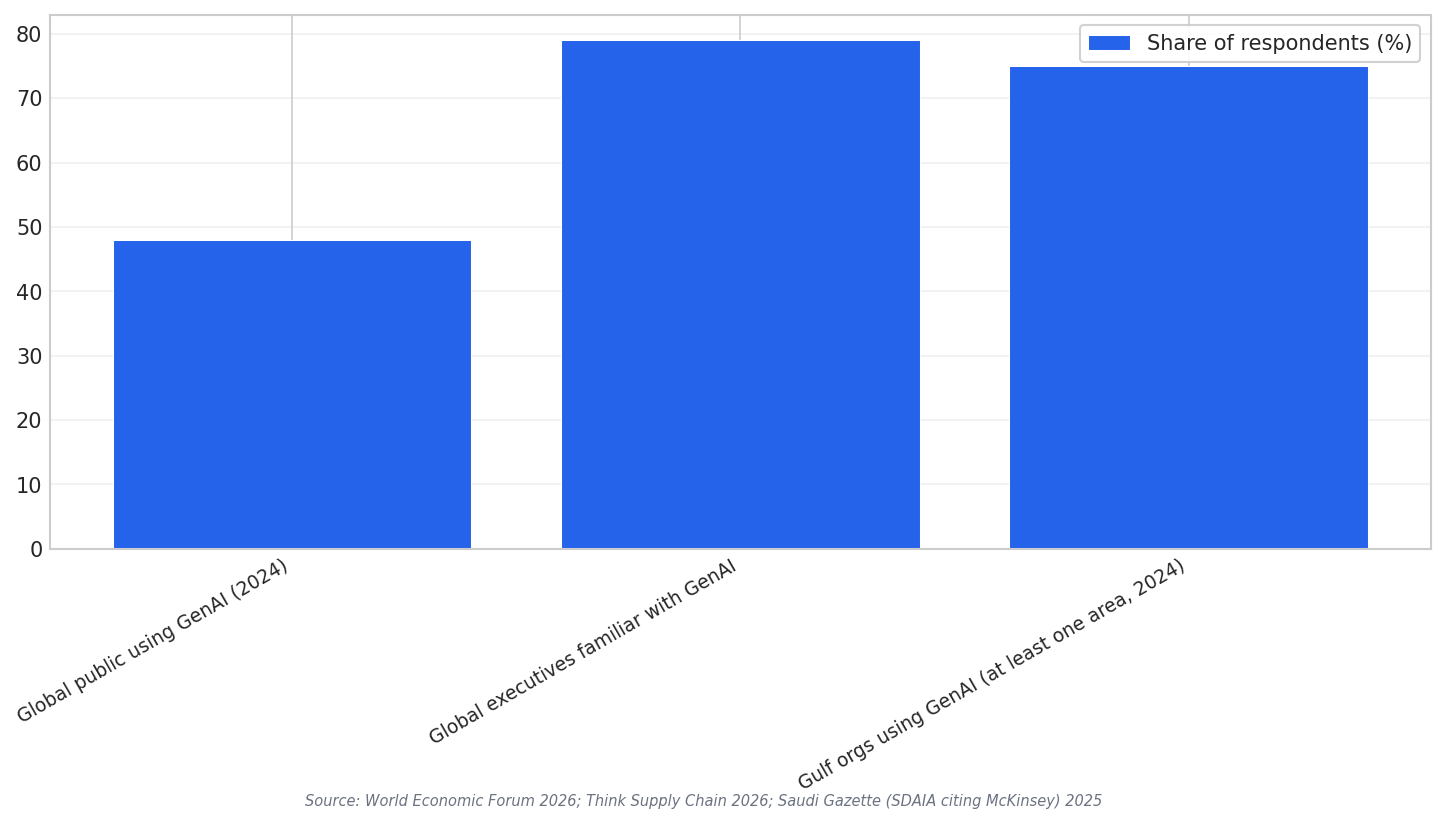
Several adoption numbers help show why this moment matters. In 2024, 48% of the global public reported using generative AI. Another readiness signal is that 79% of global executives have familiarity with generative AI. In the Gulf region, a 2024 McKinsey study of 140 public and private sector organizations found that 75% of participants were using generative AI in at least one area.
In supply chain operations, early Saudi adopters are focusing on real business pain. Research highlights pilot programs for high-impact use cases such as demand forecasting and warehouse automation. In logistics, generative AI can enable real-time visibility into fleet performance and fuel optimization. Early adopters also report reduced inventory costs by 15–20%.
From Experiments to Scale: What Saudi Teams Need
Scaling is not only about buying a tool. The same research lists strategic imperatives that make deployments work. These include modernizing data infrastructure for real-time model training, partnering with enterprise AI providers and public cloud platforms like AWS and Azure, and setting cross-functional AI governance boards across operations, IT, and compliance. Workforce upskilling is also listed as a must so teams can interpret AI outputs.
Evidence from Saudi industry also shows that generative AI links to sustainability outcomes, not only speed. A study surveyed 347 senior managers from 50 manufacturing companies in Saudi Arabia that actively used GAI. It found that GAI is significantly associated with sustainable supply chain performance, both directly and indirectly through green process innovation. The same study also found technological competence has a direct positive relationship with sustainable supply chain performance, but it moderates the GAI link negatively, suggesting integration can be difficult at high capability levels.
Investment signals are growing. In March 2024, the government announced a $40bn fund dedicated to AI investments aimed at optimizing operations, reducing waste, and strengthening decision-making. The World Economic Forum also described an AI-driven SUSTAIN platform that could unlock $20 billion by 2030, while accelerating partnership formation for high-impact projects potentially worth up to $100 billion in the wider MENA region. Together, these signals suggest the next phase is about moving pilots into repeatable supply chain value.
What does “Generative AI Saudi supply chain” mean in practice?
What proof exists that generative AI is already being used in the region?
What results are early supply chain adopters reporting?
What helps Saudi organizations scale GenAI beyond pilot projects?
Where does the “$20B” figure come from?
Talk to us for your needs in:
- Identifying Suitable Warehouse Sites in Saudi Arabia
- Customized Logistics and Supply Chain Analytics
- Logistics Network Design and Optimization
- Green Supply Chain and Sustainable Logistics Solutions
- Supply Chain Risk Management and Compliance
- Advanced Supply Chain Resilience and Agility
- Logistics Market Research and Strategic Analysis
- In-Depth Market Survey for Logistics
- Market Intelligence and Insights in Logistics
- Feasibility Study and Assessment in Logistics
- Integrated Warehousing Management Solutions
- Smart Warehousing and Automation Systems
- Sustainable and Green Warehousing Practices
- Port and Airport Logistics Optimization
- Digital Logistics Solutions
- Saudi Logistics Benchmarking