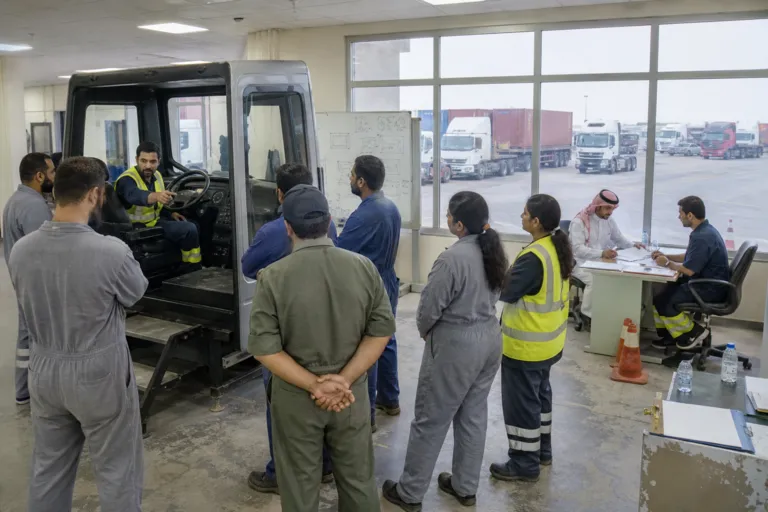
Closing Saudi Arabia’s 663 000 logistics workforce gap by 2030 depends on building job-ready skills faster than demand is expanding. Multiple sources describe an urgent need for targeted hiring strategies and agile deployment models to protect operational continuity. Innovations Group notes that rapid expansion across talent-constrained industries is outpacing the availability of skilled professionals. Logistics is also tied to wider national priorities, because Vision 2030 is pushing economic transformation and large projects that raise workforce needs. Reuters reported that 85% of Vision 2030 targets were completed or on track as of the end of 2024.
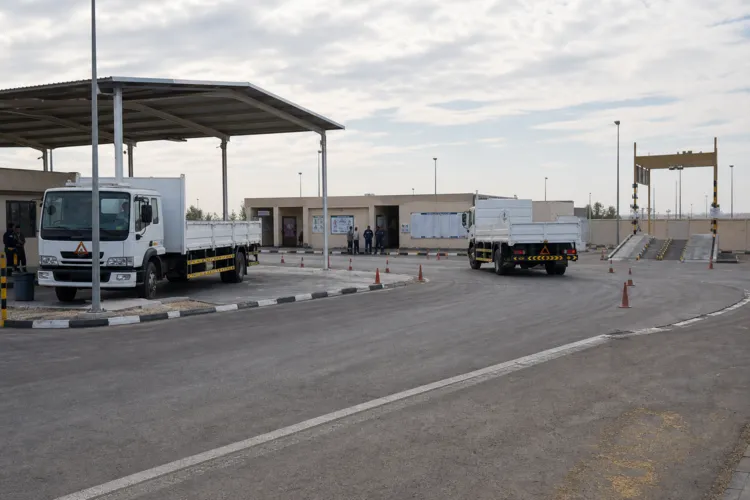
The Saudi heavy truck driver shortage sits inside this broader talent picture. The challenge is not just hiring, but matching people to specific job requirements and keeping them productive. Arab News coverage on workforce strategy emphasized that organizations need to be proactive in building teams with the needed market skills. It also highlighted that internal mobility is gaining ground to boost retention and responsiveness, while external hiring remains necessary for critical roles. This matters for logistics because it can reduce time-to-fill and help employers keep drivers and support staff engaged through clearer pathways.
What “Workforce Development” Means in Practice for Logistics
Several sources point to a shift toward skills-based development and training aligned directly to employment outcomes. At a Jeddah forum, Mustafa Hafez Al-Ansari said linking training directly to employment outcomes is essential to closing the gap between skills and market demand. Discussions also highlighted Saudization as a key driver reshaping the training ecosystem and strengthening links between skills development and employment pathways. In parallel, the Human Capability Development Program under Vision 2030 was cited as supporting the expanding role of the training sector. For logistics roles, this framing favors programs that map training to real job tasks and measurable placement outcomes.
Talent mobility providers are positioned as practical enablers of this shift. Arab News reported that talent mobility helps by upskilling and cross-training existing employees. It also noted that mobility providers help businesses navigate regulatory frameworks, sector-specific quotas, and compliance obligations. That compliance role is important in logistics, where employers often need speed and predictability in staffing to keep supply chains stable. The same Arab News report referenced the Ministry of Human Resources and Social Development’s Skills Taxonomy as a tool to align labor capabilities with evolving job demands.
Saudi Arabia’s logistics ambitions also raise the stakes for workforce planning in ports and maritime logistics. Seatrade Maritime described Saudi Arabia’s investments in maritime logistics and positioned workforce development as a key topic, including initiatives to attract and train talent to ensure long-term industry growth. Another Seatrade update described the Saudi Maritime & Logistics Congress agenda as covering workforce development alongside digital transformation, decarbonisation, regulatory compliance, and growth. These themes connect to road freight too, because heavy truck driving capacity and port throughput often rise together when trade expands.
Funding signals also point to sustained demand for workforce solutions through 2030. Innovations Group projected Saudi Arabia’s manpower supply market would reach USD 1.68 billion for blue-collar workers and USD 1.16 billion for white-collar workers by 2030, with growth rates of 3.35% and 3.86% respectively. That projection aligns with an environment where logistics employers will likely need structured partnerships to source, deploy, and retain talent. HRKatha also reported overall private-sector employment among Saudi nationals reached around 2.5 million, and that the Labour Market Strategy achieved 92% of its targets and helped bring unemployment among Saudis to 6.8% in the second quarter of the year referenced.
What is driving the Saudi heavy truck driver shortage?
How can talent mobility help logistics employers close workforce gaps?
What role does training-to-employment alignment play in closing skills gaps?
Which tools are mentioned for aligning skills with job demand in Saudi Arabia?
What do the sources say about the scale of workforce solutions through 2030?
Talk to us for your needs in:
- Identifying Suitable Warehouse Sites in Saudi Arabia
- Customized Logistics and Supply Chain Analytics
- Logistics Network Design and Optimization
- Green Supply Chain and Sustainable Logistics Solutions
- Supply Chain Risk Management and Compliance
- Advanced Supply Chain Resilience and Agility
- Logistics Market Research and Strategic Analysis
- In-Depth Market Survey for Logistics
- Market Intelligence and Insights in Logistics
- Feasibility Study and Assessment in Logistics
- Integrated Warehousing Management Solutions
- Smart Warehousing and Automation Systems
- Sustainable and Green Warehousing Practices
- Port and Airport Logistics Optimization
- Digital Logistics Solutions
- Saudi Logistics Benchmarking