

Issues
The client was a major FMCG distribution organization operating across Saudi Arabia, supplying modern trade, traditional trade, and foodservice channels. Rapid expansion in consumer demand placed pressure on the logistics network, pushing the company to reassess its warehousing footprint to support long-term growth. They required a structured site identification exercise to determine ideal warehouse locations that aligned with traffic flows, infrastructure development, and retail demand patterns across Riyadh, Jeddah, and Dammam. As part of their transformation vision, leadership aimed to establish a future-ready warehousing backbone that could scale with automation and evolving customer expectations.
Solution
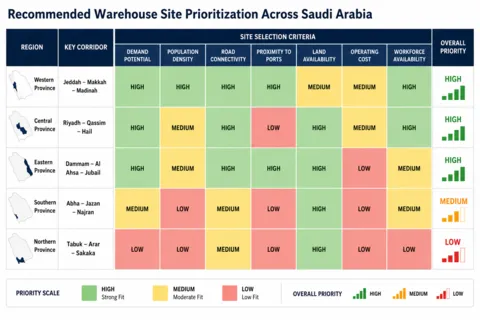
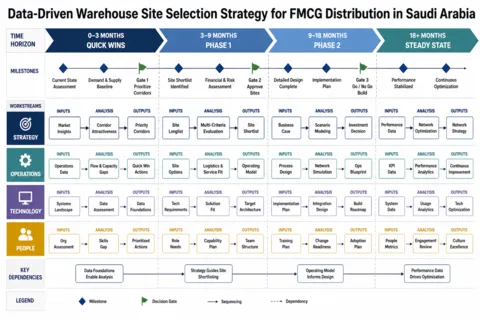
We designed a site selection solution that combined geospatial analytics, transport corridor mapping, urban demand forecasting, and regulatory feasibility assessment. The solution incorporated a multi-criteria evaluation matrix that weighted factors such as utility readiness, zoning future-proofing, multimodal access, lease pricing stability, and proximity to high-consumption districts. Advanced modelling helped classify each candidate zone into priority tiers, enabling the client to compare options in a structured, evidence-backed manner. The solution also included on-ground validation of road networks, truck maneuvering paths, traffic bottlenecks, and service availability—ensuring real-world accuracy beyond desk research.
Approach
- Mapped and forecasted consumer demand clusters across major Saudi cities to identify long-term growth corridors.
- Overlaid transportation infrastructure, including expressways and planned road expansions, to assess connectivity strength.
- Conducted zoning and regulatory reviews covering industrial land classifications and development plans.
- Performed detailed field inspections to validate truck access, congestion patterns, utility availability, and expansion feasibility.
- Facilitated cross-functional workshops aligning operations, finance, and strategy teams on weighted assessment criteria.
Recommendations
We advised prioritizing industrial zones with strong expressway connectivity, scalable plot options, and stable long-term land pricing. Additional emphasis was placed on zones already provisioned for utility expansion to support cold-chain operations. We recommended a phased land acquisition plan that allowed the client to secure strategic corridors without overcommitting capital upfront. We also encouraged developing micro-fulfillment nodes near dense population centers to strengthen last-mile performance and future automation readiness.
Engagement ROI
The client achieved significant improvements in logistics planning accuracy and cost efficiency. The selected warehouse sites reduced long-term transport expenses by approximately 18%, while service coverage improved across 14 high-density districts. Avoided site-selection errors were valued at over SAR 6.5 million, considering potential delays, inadequate utilities, or congestion risks at poorly selected locations. The final strategy created a scalable warehousing foundation capable of supporting 8–10 years of business expansion.
Talk to us for your needs in:
- Identifying Suitable Warehouse Sites in Saudi Arabia
- Customized Logistics and Supply Chain Analytics
- Logistics Network Design and Optimization
- Green Supply Chain and Sustainable Logistics Solutions
- Supply Chain Risk Management and Compliance
- Advanced Supply Chain Resilience and Agility
- Logistics Market Research and Strategic Analysis
- In-Depth Market Survey for Logistics
- Market Intelligence and Insights in Logistics
- Feasibility Study and Assessment in Logistics
- Integrated Warehousing Management Solutions
- Smart Warehousing and Automation Systems
- Sustainable and Green Warehousing Practices
- Port and Airport Logistics Optimization
- Digital Logistics Solutions
- Saudi Logistics Benchmarking