

Issues
The client was a large consumer goods manufacturer operating across Saudi Arabia, supplying both modern trade retailers and regional distributors. Their supply chain required higher resilience due to unpredictable demand spikes, supplier volatility, and capacity constraints across multiple import lanes. With growing exposure to regional disruptions, the company sought a structured framework to strengthen resilience and improve agility across sourcing, inventory planning, and logistics execution. Their leadership aimed to modernize the organization’s readiness level to ensure uninterrupted service even under unpredictable conditions.
Solution
The client was a large consumer goods manufacturer operating across Saudi Arabia, supplying both modern trade retailers and regional distributors. Their supply chain required higher resilience due to unpredictable demand spikes, supplier volatility, and capacity constraints across multiple import lanes. With growing exposure to regional disruptions, the company sought a structured framework to strengthen resilience and improve agility across sourcing, inventory planning, and logistics execution. Their leadership aimed to modernize the organization’s readiness level to ensure uninterrupted service even under unpredictable conditions.
Approach
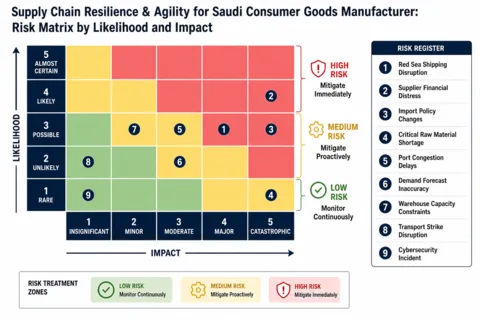
- Conducted end-to-end risk mapping across suppliers, transport lanes, warehouses, and production facilities.
- Built disruption scenarios covering geopolitical risks, port congestion, supplier failures, and internal breakdowns.
- Modeled dynamic safety stock levels using advanced forecasting tools for high-risk SKUs.
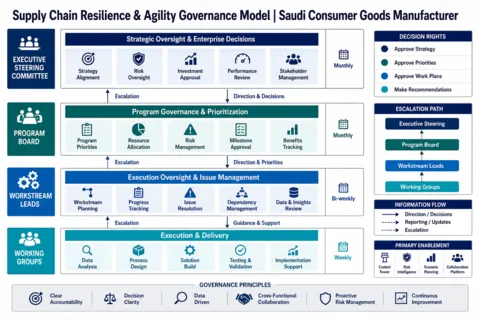
- Designed governance structures for rapid cross-functional coordination during disruptions.
- Provided resilience training and simulation workshops for internal teams to strengthen response readiness.
Recommendations
We advised diversifying key suppliers, establishing fast-track approval workflows, and implementing dynamic inventory allocation. Additional recommendations included creating a centralized control tower for monitoring lead-time risks, strengthening collaboration with logistics partners, and conducting periodic resilience stress tests. We also suggested investing in flexible transport contracts and secondary hubs to maintain continuity during lane disruptions.
Engagement ROI
Supply chain responsiveness improved significantly, with disruption impact reduced by 35% and recovery time after delays shortened by 42%. Emergency freight costs fell by SAR 2.7 million annually, while service-level stability improved across modern trade customers. The enhanced resilience framework provided long-term confidence for expansion into emerging Saudi regions.
Talk to us for your needs in:
- Identifying Suitable Warehouse Sites in Saudi Arabia
- Customized Logistics and Supply Chain Analytics
- Logistics Network Design and Optimization
- Green Supply Chain and Sustainable Logistics Solutions
- Supply Chain Risk Management and Compliance
- Advanced Supply Chain Resilience and Agility
- Logistics Market Research and Strategic Analysis
- In-Depth Market Survey for Logistics
- Market Intelligence and Insights in Logistics
- Feasibility Study and Assessment in Logistics
- Integrated Warehousing Management Solutions
- Smart Warehousing and Automation Systems
- Sustainable and Green Warehousing Practices
- Port and Airport Logistics Optimization
- Digital Logistics Solutions
- Saudi Logistics Benchmarking